
Articles

Improving apologies in healthcare deaths
This paper examines three child deaths and the challenge in getting healthcare professionals to offer sincere apologies to victims’ families. The cauldron of emotion generated by child deaths makes this particular context for apology worth studying—for if we can distill the essence of good apology in these horrific situations, we can craft a template for success for apologies in all aspects of life. Read the full paper.
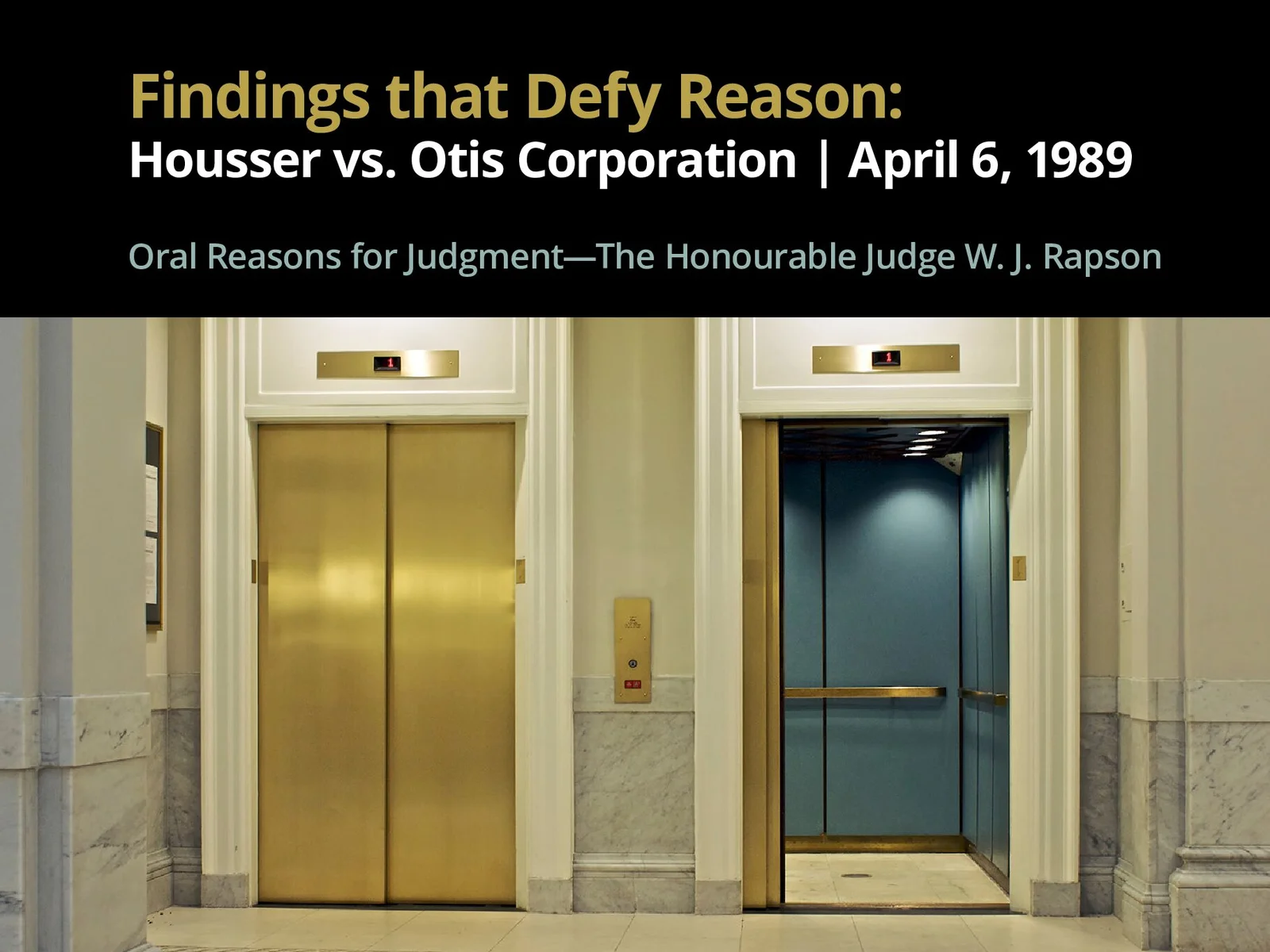
Findings that defy reason
There is no shortage of jury findings that seem perverse in light of the facts. One case that stands out for me involved an elderly woman who suffered injuries boarding an elevator that had failed to level at floor level. The woman refused what she considered a low settlement offer from the elevator manufacturer, preferring to take her chances in court. But the jury found she had not proven the elevator was not level, leaving the victim with significant court costs. In response to the plaintiffs’ motion to set aside the jury’s verdict as perverse, the trial judge acknowledged that Otis’s pretrial offer of settlement was only one third of what would have been a fair settlement. Though the trial judge completely disagreed with the jury’s verdict, he refused to intervene. As such, his Honour dismissed the plaintiff’s motion to set the jury verdict aside. Read the decision here.
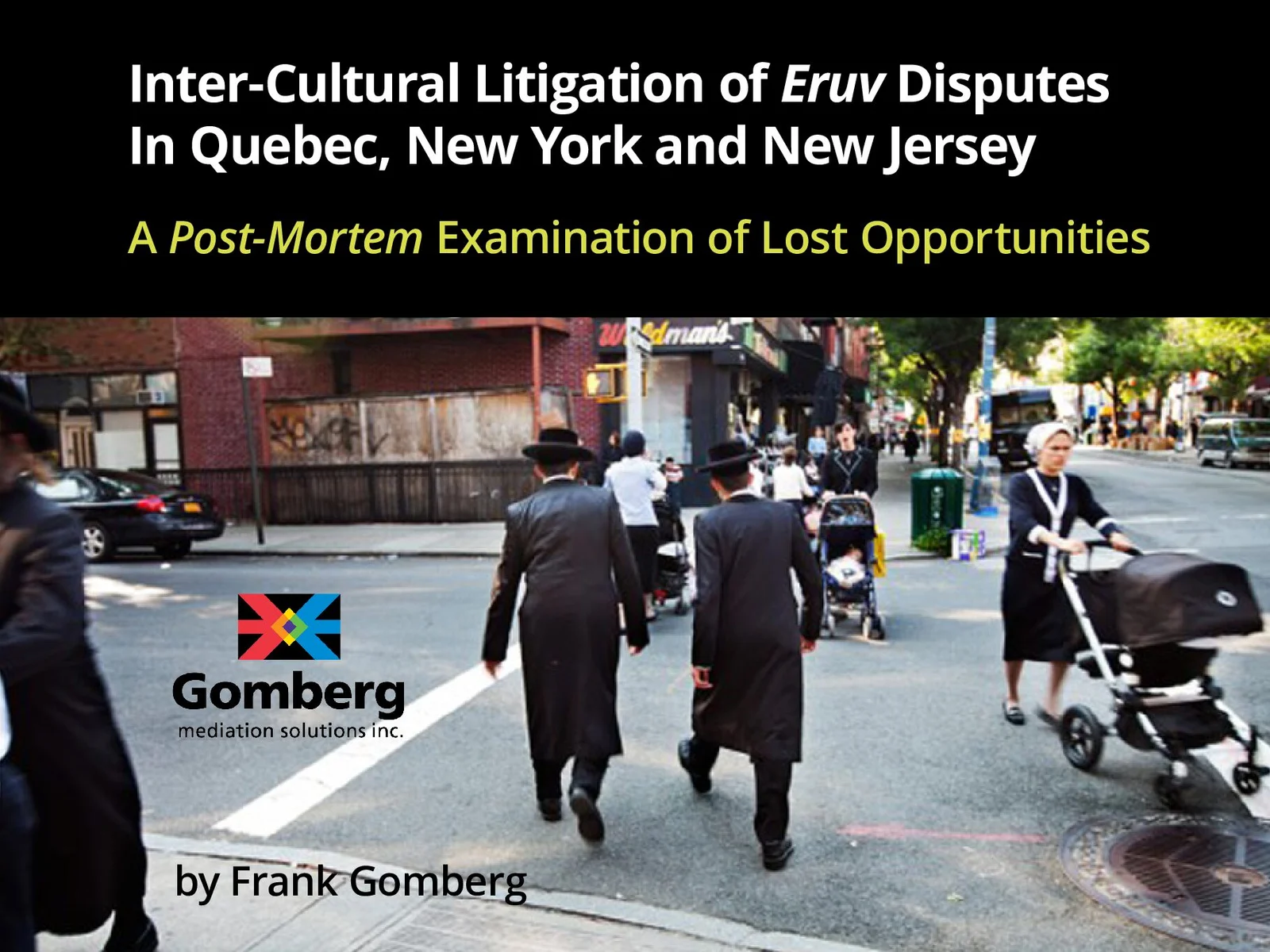
Avoiding conflicts arising from cultural difference
Fractious relationships between Hasidic Jews and the neighbouring non-Jewish communities in Outremont, Quebec; New York City; and in Long Branch and Tenafly, New Jersey ultimately produced lawsuits in each of these jurisdictions. This paper examines the litigated claims and extracts lessons that can be learned from these failed relationships. Read the full paper.
Analytical critique of civil justice
This paper explores issues including the need for subject matter expertise in Superior Court judges; the dubious value of pre-trial conferences and the merits of mandatory mediation in certain Ontario jurisdictions. Read the full paper.
Anatomy of a mediation in a child’s wrongful death case
Based on mediating hundreds of wrongful death cases and acting as counsel in others, Frank analyses how a trial will always exacerbate an already horrible situation. It is imperative in these high emotion cases that the mediator should embrace the Hippocratic oath and “do no harm”. If the case can be settled at mediation, then the grieving family members can focus on their lives and not on their lives and on the lawsuit. It is obscene to talk about closure. On a good day, there is closure of the lawsuit only. The most that can be achieved in this tragic subset of civil cases is a benign process that is less adversarial than a trial. Read the full paper.
Reflections On Teaching, Training and Coaching
Successful learning demands a continuous communication loop that ensures the learner understands what the teacher is saying. This does not only apply to teaching bu it also applies to jury trials. Is the jury getting what the lawyer is “pitching”? Success is measured by what is by definition difficult to measure. Is the listener “hearing” what the speaker is really saying? This paper uses pictograms, karate, bicycle gears and the Myers-Briggs Type Indicator to argue for systems that accommodate a diversity of learning styles.
Perceived Power Imbalances on Mediations
This paper explores perceived power imbalances and posits that once the fight starts (or the case goes to Court), Goliath will “win” most of the time. However; the win may be at great cost to Goliath; a cost David should exploit in negotiating a mediated settlement. Read the full paper.
Choose a mediator credible to the other side
Even if you have a list of preferred mediators with, say, five names on it, it still makes excellent sense to have the other side propose the mediator. This effectively minimizes the other’s possibility of demeaning the mediator’s competence or views at the mediation. Unless the other side picks someone unacceptable to you, simply go along with the mediator selected by your opponent. If the other side proposes someone entirely unacceptable, exchange lists of acceptable mediators and pick the mediator together. By engaging in joint selection, neither counsel can argue to the other side at the mediation: “You picked the mediator—why don’t you listen to what she’s saying?” For more, see page 23 of this article in the October 2012 issue of The Litigator magazine.
Choosing between a passive and an active mediator
Mediator style is an interesting and somewhat controversial topic. In my view, there are very few cases that cry out for a passive mediation style and very few that cry out for an aggressive, in-your-face style. My advice? Be more concerned with what may resonate with the other side than with the style you find comfortable. Why? Because at the end of a contentious negotiation, the mediator’s input will be greater when he does “reality testing” with someone who respects his opinion and is comfortable with his style. If you can predict that the other side will be comfortable with an active “in-your-face” mediator, then that style may be preferable, even if you might prefer a less aggressive mediator—as long as you and your client can live with this aggressive style. For more, see pages 23-25 of this article in the October 2012 issue of The Litigator magazine.
The importance of opening statements
The importance of opening statements: The opening statement may be the only chance in the mediation—and perhaps in the life of the litigation—for the plaintiff’s lawyer to address the insurer directly and for the defendant’s lawyer to address the plaintiff directly. This opportunity to put one’s case to the decision-maker without filters is truly unique and ought not to be missed. Given this reality, there is no excuse for a poorly constructed or a poorly executed opening statement. For more, see page 61 of this article in the December 2012 issue of The Litigator magazine.
Mediation is the real home of civil law advocacy | Frank Gomberg